
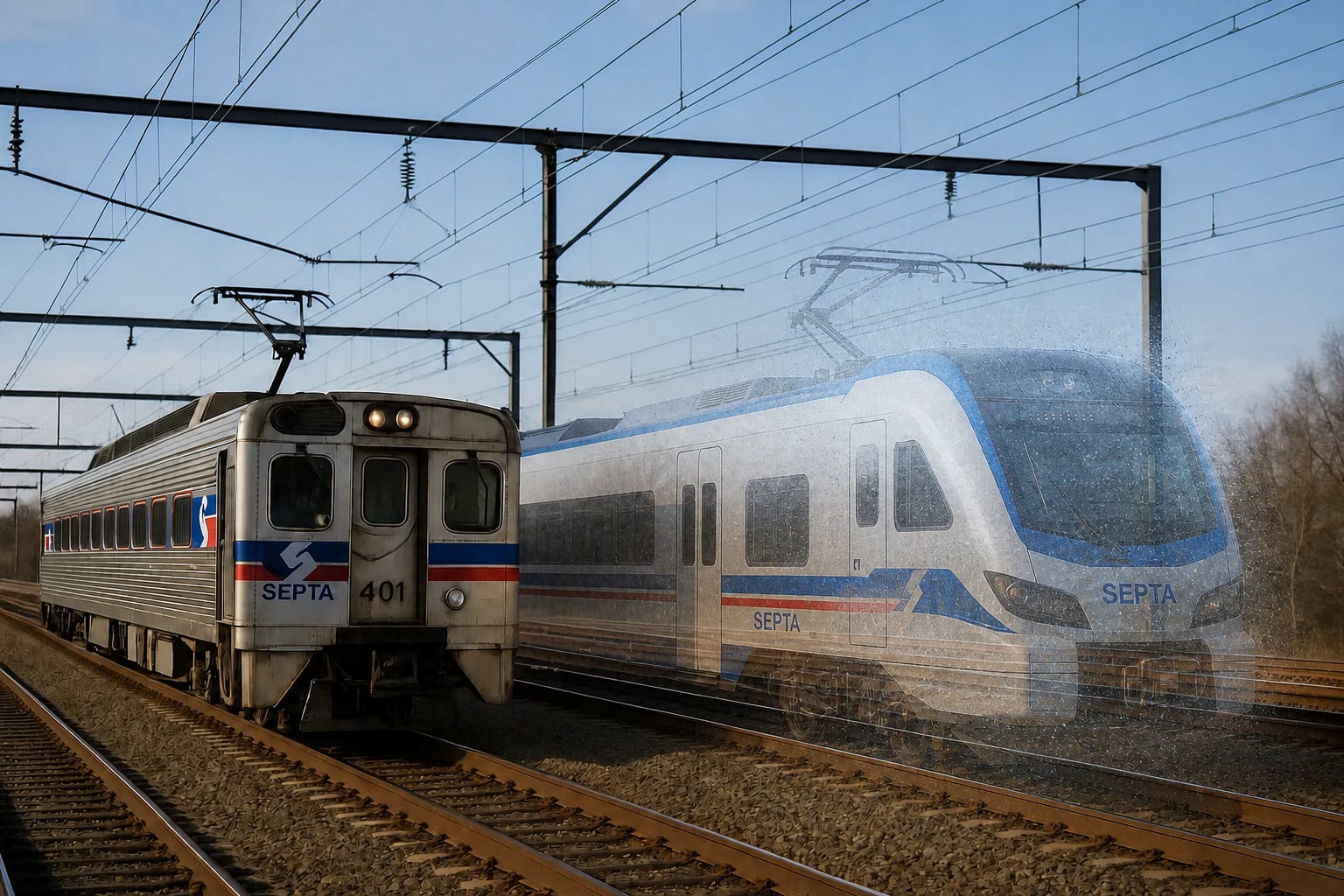
It’s been seven months since I last wrote about the Silverliner VI procurement. At the time, I proposed amending the RFP to allow modern set-based EMUs with wide doors, level boarding, a sealed crash-energy nose, and unpowered cars. Since then, SEPTA has issued ten addenda — with the tenth being 59 pages of edits to the entire technical specification. This post is an update on where things stand as of August 2026, based on the addenda SEPTA has published and the public record.
Credit where due. The SEPTA that issued this RFP in November was a prescriptive buyer rehashing a 2010 specification line by line. The revised specification is more flexible and realistic, turning dozens of hard numbers into “propose it and justify it.” But on each of the five proposals - no movement.
Addendum 10
Addendum 10 is not another batch of Q&A. It withdraws the technical specification issued with the RFP and replaces it with an August 2026 version, plus a redline and a 59-page change matrix. Every section from 1 through 27 was touched — some trivially (“should” to “shall,” metric equivalents, alphabetized standards), some not.
Read the matrix end to end and a pattern emerges. Over and over, a fixed number or a named product becomes “may be proposed for Approval”: the transformer relief-valve setpoint, the vacuum-transformer design, the insulation UA value, contact types, FMECA methodology, seat foam, even cupholder dimensions. Whole subsections become “Not Used.”
The substantive changes worth knowing
The energy targets are gone. The original specification capped net energy use at 7.3 kWh per mile per married pair and auxiliary load at 45.895 kW. In Addendum 9 (Q187, Q194) a bidder called the targets — including the 3.1125 kWh/mile-per-car figure in the contract documents — “virtually unachievable,” and SEPTA promised a process to instrument and test a Silverliner V pair. Addendum 10 then struck this section entirely and did not implement that promised baseline procedure. The replacement specification instead requires simulations at the proposal and design-review stages, followed by testing that compares actual consumption with the builder’s own prediction and reports the percentage deviation.
“Service proven in North American commuter railroad service” is deleted. The propulsion clause (TS 10.1.1.A) most likely to screen out a European or Asian traction package now reads “a service proven design appropriately sized to meet the performance, towing, and duty cycle requirements.” This more flexible language is likely to open up more competition and was a bidder’s ask in Addendum 3, Q27.
The transformer moved to the international standard (IEC 60310) and the fixed impedance number became performance language. I’ll come back to why this matters for traction power.
The pantograph clause changed by one word. The requirement that the pantograph be “totally interchangeable” with the Silverliner V’s became “functionally interchangeable” (TS 10.14.1.A.3) — the exact edit the competitive-solutions bidder requested in Addendum 6, Q73. “Shall mount exactly on the pantograph insulators” survives intact. The overhaul interval went from 10 years to 7 (TS 10.14.1.A.4).
Carbody strength basis was lowered from crush load to fully seated load. TS 3.3.1.5.A now requires the carbody to survive its 40-year fatigue life at AW2 (full seated load plus some standees) rather than AW3 (crush load). Braking, by contrast, was raised to AW3 (TS 2.9.3.F). A defensible change given the operating environment, and a consistency fix — TS 2.1.9.B already said AW2.
One notable rejection: No sanders. A proposer inquired about a sanding system to improve traction, braking, and reliability during the fall “slippery rail season”: “Considering the operating conditions seasonally such as dew, frost and leaf oil accumulation, the sanding system would be needed to increase the available adhesion” (Addendum 3, Q45). Sanders (which dump sand on rail to improve traction) aren’t a cure-all — but they are a widely used tool on modern EMUs for exactly these conditions and could potentially help with schedule reliability during the fall. SEPTA’s answer: “A sanding system shall not be provided. SEPTA believes the specification can be met without the use of sanding systems.” A vendor volunteered the capability and SEPTA turned it down flat.
And smaller items. The Test & Inspection married pair was removed from the car types and Section 28 is explicitly marked “Section Deleted” (TS 2.1.10.A.3.b); the minimum-curve design requirement was relaxed from 220 to 250 feet, making the train less tight-curve-capable (Table 2-2); the emergency lighting reserve was halved from 180 to 90 minutes (TS 8.4.1.E); the full-time on-site reliability engineer became on-call support with a one-week response (TS 21.6.4.A.10); the truck overhaul interval went to 610,000 miles and the design life is now stated as 2,440,000 miles (TS 2.1.9.A, 10.10.1.B).
The reissued spec now states the design life explicitly: 40 years. For the last cars off the line in the mid-2030s, that lands on 2076 — America's Tricentennial.
Proposed Amendments
In December I published five proposed amendments framed to preserve SEPTA’s safety, accessibility, and performance requirements while converting a prescribed design into a performance outcome. Here is the scorecard, zero for five:
Mixed consist architecture — allow formations beyond married pairs with unpowered trailers as priced optional alternates alongside the baseline married-pair bid (Physics or Fantasy? and Silverliner as a Sprinter Salvage Strategy). No movement. The reissued spec promotes the married-pair clause to the top of Vehicle Configuration (TS 2.1.10.B) and drops single-car operation from the analysis envelope (TS 2.8.5.A.1.d); the Q&A counts the base order in pairs and tracks delivery by pair. No trailers, no unpowered cars, no sets — the words do not appear.
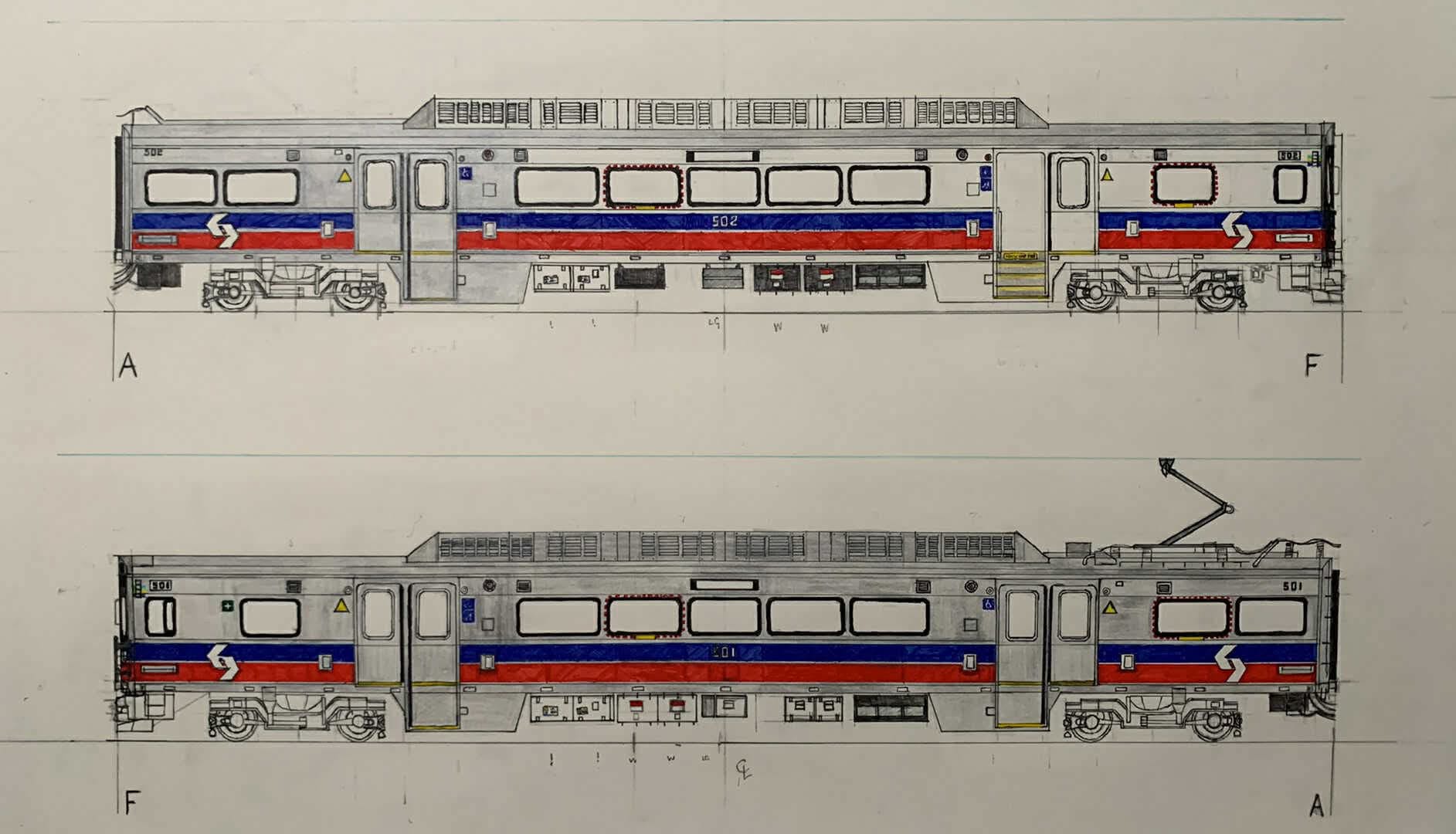
Front cab configuration optionality — allow designs without the full-width walkthrough nose door, provided all FRA egress requirements are met (The $50 Million Door). No movement. Addendum 10 reaffirms the full-width cab (TS 5.1.1.1), and requires flush, single-leaf end doors at both ends (the front “F-end” with the cab and the aft, “A-end”) of every car (TS 6.3.1.A).
Level boarding as a performance requirement — let vendors demonstrate step-free boarding at 48-inch platforms rather than hard-coding a 51-inch floor (Doors and Floors). No movement. The floor stays at 51 inches (Table 2-1), and one Q&A answer makes the consequence explicit: a bidder said an onboard ramp was necessary to meet ADA gap standards; SEPTA prohibits onboard ramps, stating that “bridge plates located on the platforms can meet ADA requirements” (Addendum 3, Q37). Asked whether the same prohibition applied at high-level platforms, SEPTA answered, “Confirmed” (Addendum 9, Q202). The three-inch step between floor and platform is officially the platform’s problem. SEPTA will use bridge plates (a metal ramp a crew member manually places for each wheelchair boarding) at every high-platform station, for the life of the fleet (circa 2076).
Door configuration flexibility — permit wider dual-leaf doors up to ~51 inches, with placement backed by passenger-flow analysis (More Doors and Floors). No movement. Single-panel pocket doors, all the same width (34 to 36 inches) with two per platform height per side (TS 6.1.A, 6.2.1.A), are reaffirmed, with the plug-door alternative now requiring written justification (stricter than before).
Traction power optionality — permit (not require) modern multi-voltage capability alongside mandatory 11.5 kV/25 Hz operation (Wires and Volts). No movement. The catenary section (TS 2.7) is unchanged, and 25 kV/60 Hz appears nowhere in the reissued specification — not as a requirement, an option, or a future-proofing note — and the alternates clause offers no path to propose it. The new fleet will be electrically locked to 1915 infrastructure well into the 21st century.
As to what the future holds — a Silverliner 5.1, a rehash of what Philadelphia already runs, or Silverliner XXI, a modern EMU designed for the service of the future — the reissued specification gives an unambiguous answer. We are getting 5.1.
Steelmanning the spec
It’s worth taking seriously the strongest case for SEPTA’s choices — one argument per amendment.
On set-based trains: “the shops can’t maintain them.” Of the five refusals, this is the only one with a genuine engineering trade behind it. SEPTA’s maintenance facilities were built around two-car units. Therefore, the shape of a fleet expected to be in service at the tricentennial will be determined by current shop configuration. In Physics or Fantasy? I estimated roughly $200 million in vehicle capital savings from unpowered trailers versus the cost of shop modifications to service them. Nobody has to take my numbers on faith — that trade is precisely what a priced alternative in the RFP would test with real vendor pricing.
On the nose door: “passengers and crews must pass between cars on long trains.” SEPTA runs trains longer than four cars, and under a married-pair architecture, crews cross between pairs through cab-end doors. There are solutions — but once the married pair is fixed, this is what follows.
If SEPTA is committed to using married pairs in an (F-A)—(A-F) configuration, you could still have open gangways between the two A-ends of the cars within a married pair. This would improve circulation within a married pair for both passengers and crew. But SEPTA won’t allow it. The specification requires a full-length, inward-swinging end door at that end too. Reason unknown. SEPTA’s forthcoming Hitachi trains for the Market-Frankford line have open gangways.
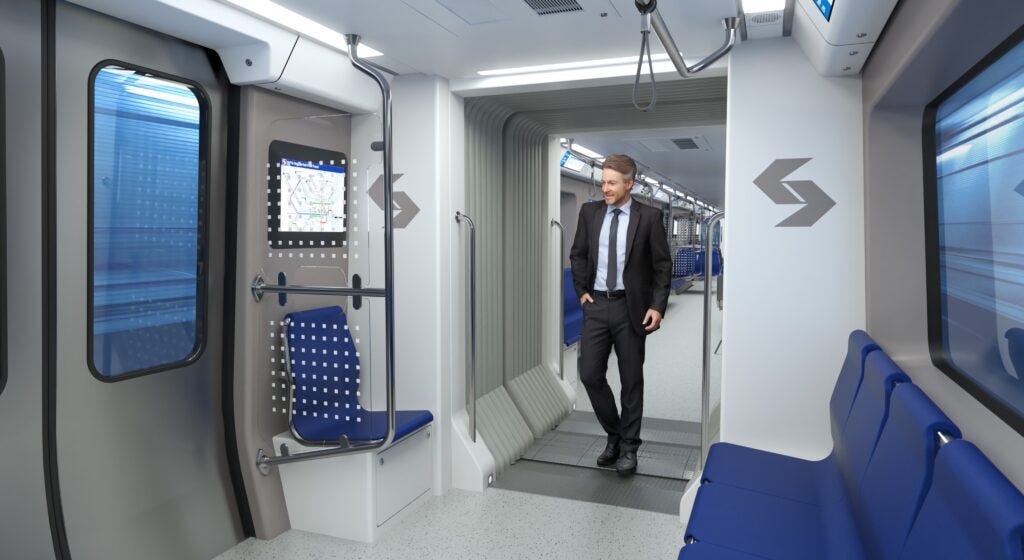
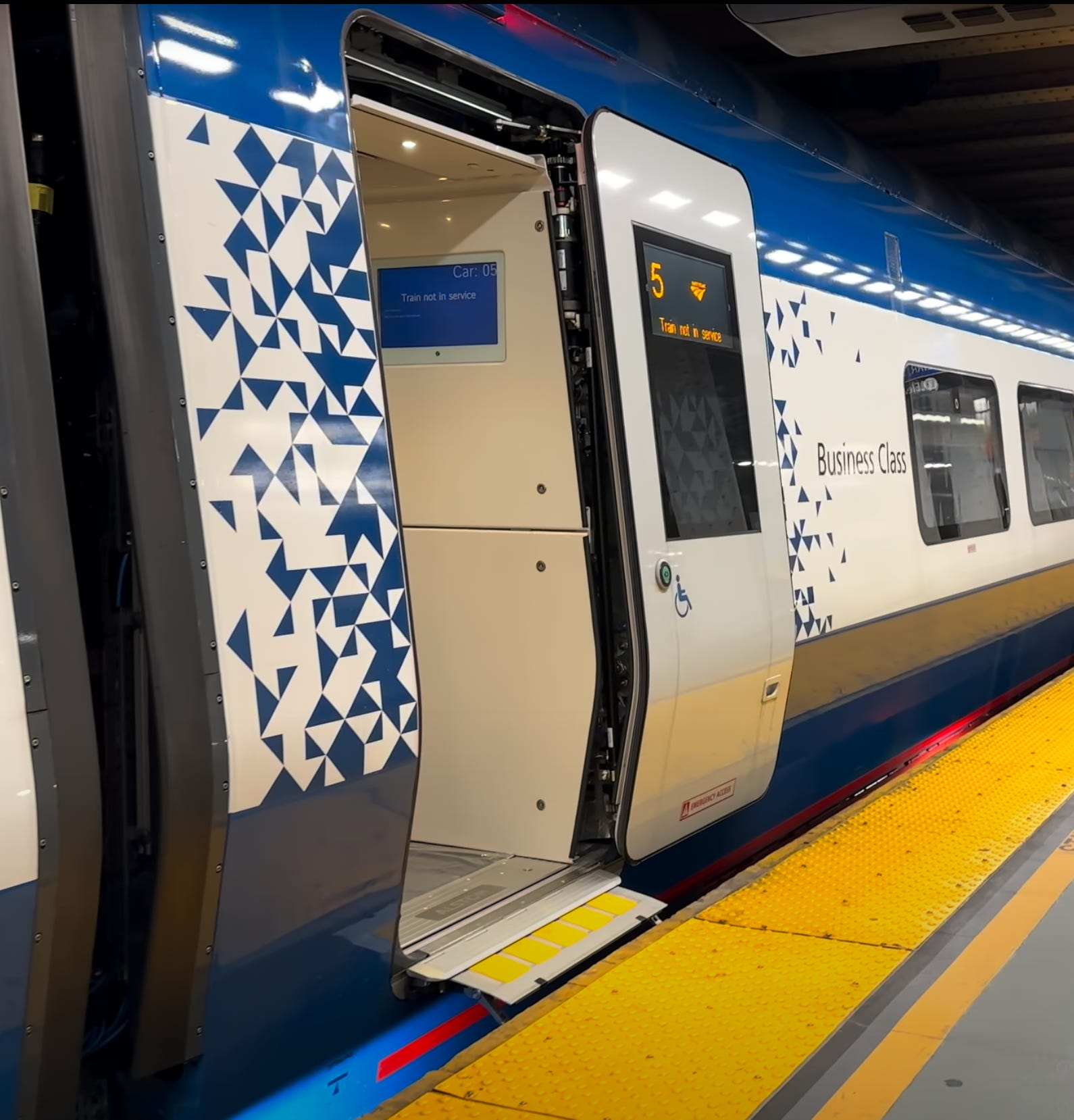
On floor height: “the NEC standard protects against wheel wear.” The 51-inch floor is the Northeast Corridor standard and exists because as the wheels wear, the vehicle floor height drops. The 51-inch floor requirement guarantees the floor never ends up below the platform. However, Denver’s RTD faced the same wheel-wear reality with its Silverliner V and still has platforms within a half-inch of the vehicle floor. How do they operate with only a half inch gap between the platform and the floor of the train? Worth a ponder. A performance requirement — 51 inches or level boarding under all wheel wear conditions — leaves vendors and station designers to develop the best solution. Instead SEPTA is choosing manual bridge plates, at every high platform, for the life of the fleet. Even the small automatic ramps — like on Amtrak’s latest offerings in the same corridor — are banned.
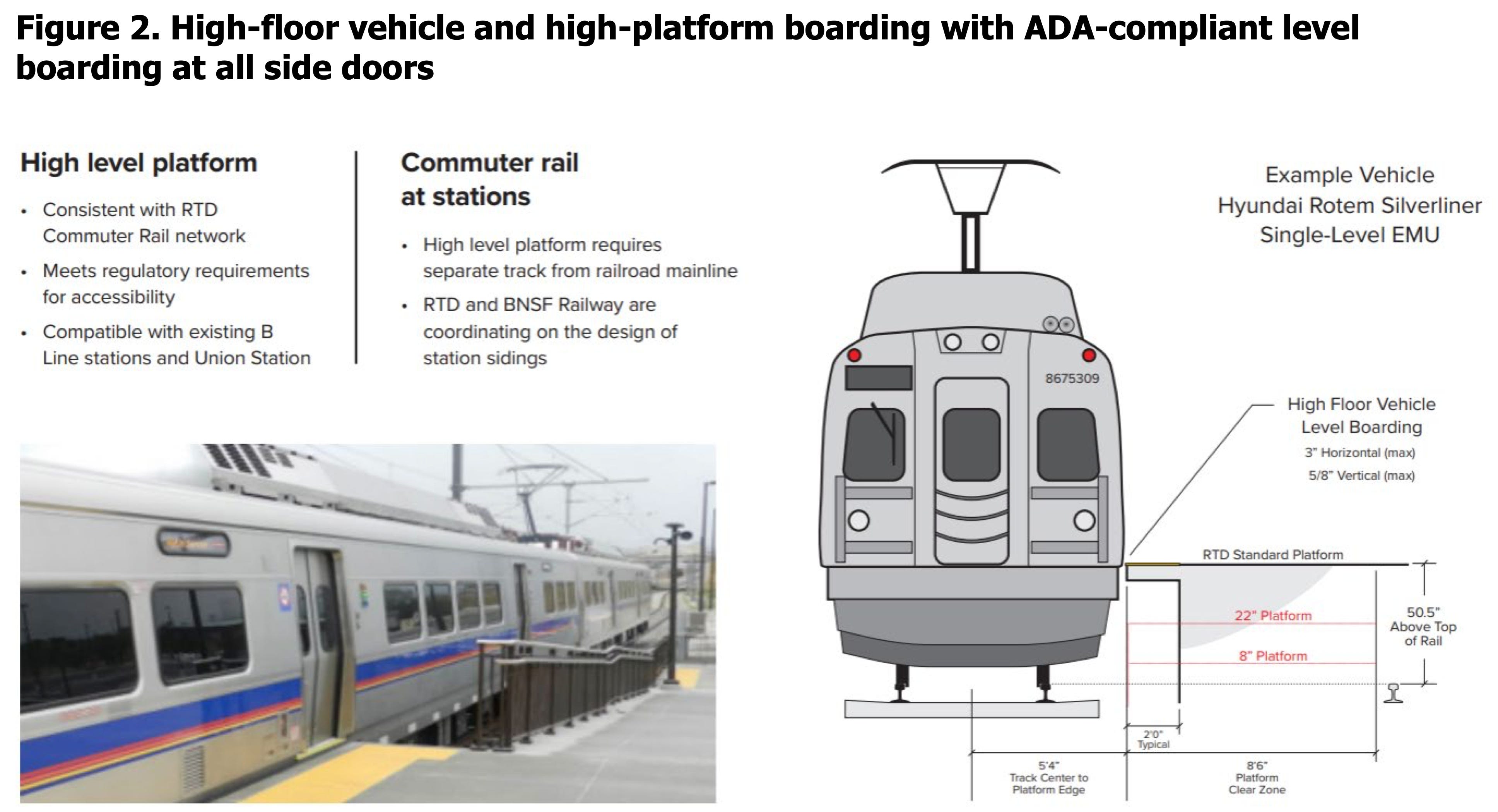
On doors: “width must be balanced against seating.” This is the weakest of the five, because it defends a trade-off the spec never actually lets anyone make. Balancing doors against seats is a real design decision — but the RFP doesn’t balance it, it forecloses it, prescribing narrow doors.
In its own budget, SEPTA agrees. The agency’s FY 2027 Operating & Capital Budget Proposal sells the Silverliner VI to riders and legislators with the promise of “wider side doors that will decrease the time needed to board and alight from the train,” because — in SEPTA’s own words — “such improvements will increase the operating efficiency of SEPTA Regional Rail service, providing our customers with faster service while reducing operating costs.” That is the argument of this blog, stated nearly verbatim, in the document that funds the program.
Section 6.1.A.5 requires single-panel doors with a “free clear opening at passenger doorways between handrails” of 34 inches minimum, expandable to a maximum of 36 — but only “if the number of passenger seats is not impacted.” The new fleet’s doors will only be two to four inches wider than the ADA minimum (49 CFR §38.93); even at 36 inches, each doorway is still single file. Faster boarding comes from dual-leaf doors up to 51 inches wide enough for two passenger streams at once. SEPTA’s budget office is promising the benefit; the specification forecloses the possibility.
The trade, when you actually run it, is quantifiable: the layout I published in More Doors and Floors gives up four seats per car to move from 136 inches of high-platform door width per pair to 204 inches, doubling simultaneous boarding streams at Jefferson and Suburban. This is something a vendor passenger-flow analysis could test if SEPTA allowed it.
Like on the Silverliner V, SEPTA wants two doorway types — high-level doors that open straight onto the platform, and low-level doors with a fixed three-step well inside the car (TS 14.1.10.1–2) — two of each per side, all the same width (TS 6.1.A). High doors go at the quarter points; low doors go “either at the end of each car, with only one side door on the left side of the cab, or at approximate quarter points… adjacent to the high level doors” (TS 6.2.1.A.2). But every car has a full-width cab at the F-end and the operator’s console takes the right side, so a cab-end low door fits only on the left. That means only one low door on the right side of the lead car. So, practically, expect high and low doors paired at the quarter points.
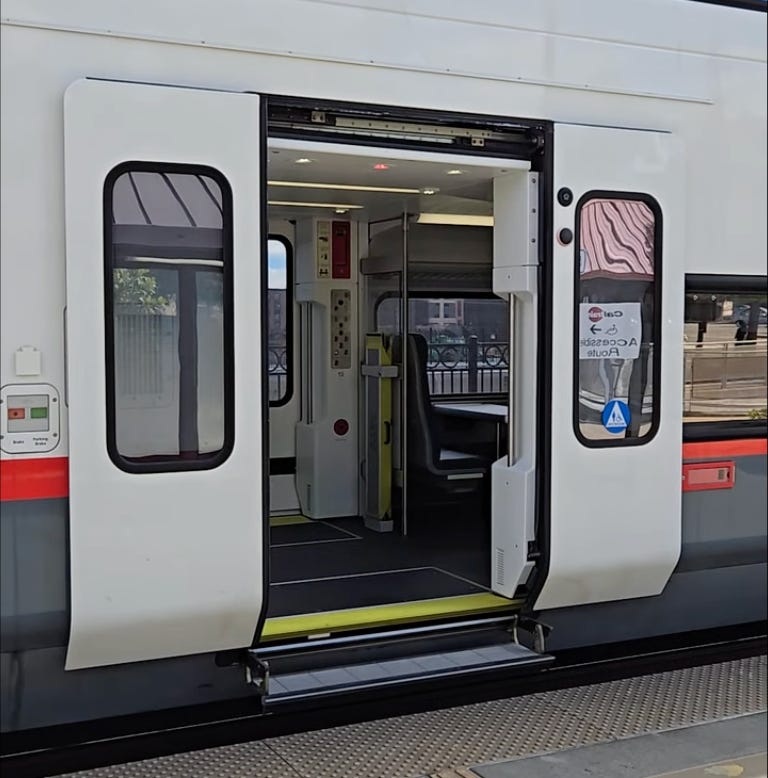
Something I missed in the winter — the stairwell configuration for low platform doors is fixed: three steps, lowest tread 17 inches above the rail, equal risers, up to a 51-inch floor. Each riser is about 11.3 inches, after a nine-inch first step up from an 8-inch platform. A comfortable stair riser is six to seven inches; building codes stop at seven to seven and three-quarters; a bus step at nine or ten is considered the tolerable limit. The device that solves this on nearly every modern regional EMU is a retractable exterior step — it adds a riser without eating vestibule floor and lets the interior steps be shallow. It runs on Stadler’s KISS at Caltrain, which faced SEPTA’s exact problem of mixed platform heights and answered it with a wide low door, an automatic exterior step, and a second set of high doors waiting for the platforms; on Stadler FLIRTs in Texas and California; on Siemens Ventures across Amtrak Midwest; and on decades of European stock through salt, ice, and grade crossings. SEPTA has never said why. The pattern—no sanders, no ramps, no retractable steps—suggests SEPTA doesn’t want to maintain additional mechanisms. That is a defensible maintenance philosophy for a shop, but bad for a rider climbing ladder-like risers with a stroller. Automatic steps and ramps are not new technology. They have been in service for decades throughout the world and SEPTA could allow vendors to offer them but require reliability data and maintenance targets like they do elsewhere in the specification.
On traction power: “we have no 25 kV to run under.” True today — the question is whether trains that could run to the tricentennial are permitted to outlive the 1915 electrification of today. Every neighboring operator says yes. Amtrak’s and SEPTA’s ACS-64 locomotives, Amtrak’s Acelas and NJ Transit’s ALP-46s are multi-voltage in the same service area. Multi-voltage traction is service proven in North America. It demands no infrastructure predicate of any kind: no shop modification, no platform work — a multi-voltage EMU runs on today’s 11.5 kV/25 Hz catenary exactly like a single-voltage one. Between now and 2076, some section of SEPTA’s catenary will need upgrades and this guarantees SEPTA will continue to be stuck on its ancient, expensive legacy standard.
Here is the strange part: the transformer section is now based on IEC 60310, the standard used by the global traction-transformer supply base and the fixed impedance rule was replaced with performance language (TS 10.21.2.E, 10.21.7.A). The train will have some of the key components of a multi-voltage train. Yet it still cannot be proposed: 25 kV/60 Hz appears nowhere in the specification, and the alternates clause operates only where the spec explicitly invites an alternative — which, for traction power, it never does. As I argued in Wires and Volts, SEPTA should price the marginal cost of multi-voltage capability. After Addendum 10, that sentence asks less of the bidders than it did in January — and it still costs the agency nothing to write.
The schedule has slipped
When the RFP was issued in November 2025, questions were due January 30 and proposals were due April 10, 2026. In response to vendor questions & pushback, the schedule was adjusted. The question deadline is September 25 and proposals are due October 30.
Because the revised specification will generate new questions, another addendum and schedule extension is likely.
What SEPTA expects the Silverliner VI to cost
SEPTA’s latest capital budget contains new information unavailable in January which tells you what SEPTA expects the program to cost. The FY 2027 budget programs $2.117 billion for the Silverliner IV Vehicle Replacement: $88 million in prior funding plus $2.03 billion across FY 2027–2038, on a curve that mirrors the procurement schedule — $28 million through FY 2029 for design review and early milestones, a production ramp beginning at $197 million in FY 2030, annual funding of roughly $200–300 million through FY 2036 (peaking at $298.6 million in FY 2034), and a tail running out through FY 2038.
If roughly 10% of the remaining $2.03 billion is reserved for project management, consulting, and other owner-side costs, about $1.83 billion would remain for the carbuilder. I am unsure whether SEPTA’s capital budget includes the price of the two 46-car option orders. If the budget includes only the first 234 cars, then SEPTA is expecting bids at around $7.8 million per car. If they are budgeting for 326 cars (the base order plus 92 options), then SEPTA is expecting each car to cost $5.6 million. My January estimate for SEPTA’s base order was roughly $9 million per car. If the bids are over budget or money is tight, expect the savings to come from cancelled option orders.
The other number that has moved since January is the cost of the money itself. The 30-year Treasury yield, 4.86% when I last wrote, closed at 5.27% on July 31 — its highest level since 2007 — and sits at 5.25% as of mid-August. SEPTA is planning on using a TIFIA loan from the US Department of Transportation to finance roughly 49% of the program ($1.053 billion) at a fixed rate based on treasuries of comparable maturity. The agency will be borrowing at the most expensive long-term rates in a generation to buy the most conservative train it could have specified when some optionality and flexibility in the spec could have surfaced savings.
The Midterm Election
The funding backdrop hasn’t structurally changed since my September post: SEPTA still has both structural operating and capital deficits and the FY 2027 capital budget leans on a plan to borrow $4.3 billion over 12 years for railcar replacement. Governor Shapiro’s $219.9 million capital infusion last November (which also funded the leased MARC and Exo cars) bought time. The gamble was that Democrats would control the state Senate after the 2026 midterm election. That bet comes due just after bids close. The GOP-controlled state Senate currently sits at 27–23: three flips produce an outright majority. The political environment could result in a Democratic trifecta for the first time in 30 years. Under that scenario, the funding spigots open for SEPTA during the next legislative session. Which is one more reason the contract should preserve optionality now rather than foreclose it: the agency negotiating next year may be considerably richer than the one that wrote the spec.
Next Steps
The question period is open until September 25. That leaves a month during which builders or advocates can put questions on the public record. The lowest-risk version of the ask remains what it was in January: SEPTA doesn’t have to pre-select the outcome — it can allow priced alternatives and preserve its own ability to choose the best value once real numbers are on the table.
What to Watch For
First, whether October 30 holds, or whether an eleventh addendum — the one that must answer questions on the reissued spec — pushes proposals into 2027.
Second, how many proposals actually arrive. The point of a competitive RFP is plural bids. At some point, SEPTA should expect to answer how many proposals were ultimately received. If the answer is one, perhaps from a bidder with “deep Silverliner V familiarity,” federal guidance calls for determining whether the competition was adequate, or whether SEPTA’s specifications unduly restricted competition.
Third, November 3 — whether the election results in a stable source of transit funding.
The Silverliner VI will be better than the IV. The V already is. But better than IV is not the benchmark we should strive for.